


Understanding Ford Part Numbers

Ford has created two categories of numbers. Engineering Numbers and Service Numbers (Part Number)
Engineering Numbers: The number stamped on the physical part.
- The engineers are responsible for crafting a component and assigning it an Engineering part number, an alphanumeric code employed by assembly plants. If the component undergoes a redesign, it is essential to document the modification, resulting in an update to the Engineering part number.
Service Numbers (Part Numbers): The number on the box or package of a part.
- Upon release for service, the component receives a Service part number, distinct from its original Engineering part number. The differentiation arises from the unique finishing and packaging required for service, diverging from the production counterpart.
While your Ford parts provider uses the Service part number, the Engineering part number, although often visible on many parts, is not relevant to them. This dual numbering system enables Ford Parts and Service to monitor alterations influencing interchangeability, with modifications to the Ford Service part number only occurring if the change impacts interchangeability.

How To Read And Decode Ford Part Numbers


Oxygen sensors in a Ford vehicle are located in the exhaust system and help monitor the air-fuel ratio for optimal engine performance and emissions control. The exact number and placement depend on the engine type, but here’s a general breakdown:
O2 Sensor Positions
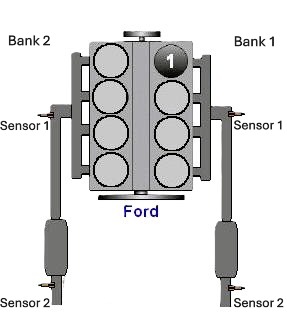
Upstream O2 Sensors (Before the Catalytic Converter)
- Also known as Bank 1 Sensor 1 and Bank 2 Sensor 1 (for V6 and V8 engines).
- Located in the exhaust manifold or just after it.
- Bank 1 Sensor 1 is where cylinder #1 is located, which is typically on the right (passenger side) for engines built in North America.
- Bank 2 Sensor 1 would then be on the opposite side of Bank 1.
- These sensors monitor oxygen levels to help adjust the fuel mixture.
Downstream O2 Sensors (After the Catalytic Converter)
- Also known as Bank 1 Sensor 2 and Bank 2 Sensor 2 (for V6 and V8 engines).
- Located after the catalytic converter on each side.
- Bank 1 Sensor 2 would be the same side as cylinder #1, typically on the right (passenger side), after the catalytic converter.
- Bank 2 Sensor 2 would be on the other side of Bank 1, after the catalytic converter.
- These sensors check if the catalytic converter is working efficiently.
Bank 1 vs. Bank 2 – Passenger or Driver Side?
- For North American built engines, Bank 1 is where cylinder #1 is, which is usually on the right (passenger side).
- Bank 2 would be the opposite side of Bank 1 (for V6 and V8 engines).
- On inline 4-cylinder engines, there is only Bank 1, so all sensors are on the same side.
Typical Ford Configurations
- 4-Cylinder Engines: 2 sensors (one upstream and one downstream, both on the same side).
- V6 & V8 Engines: 4 sensors (two on the passenger side and two on the driver’s side).
If you need to locate or replace a specific O2 sensor, contact our team with your VIN and we can find the right part for you!